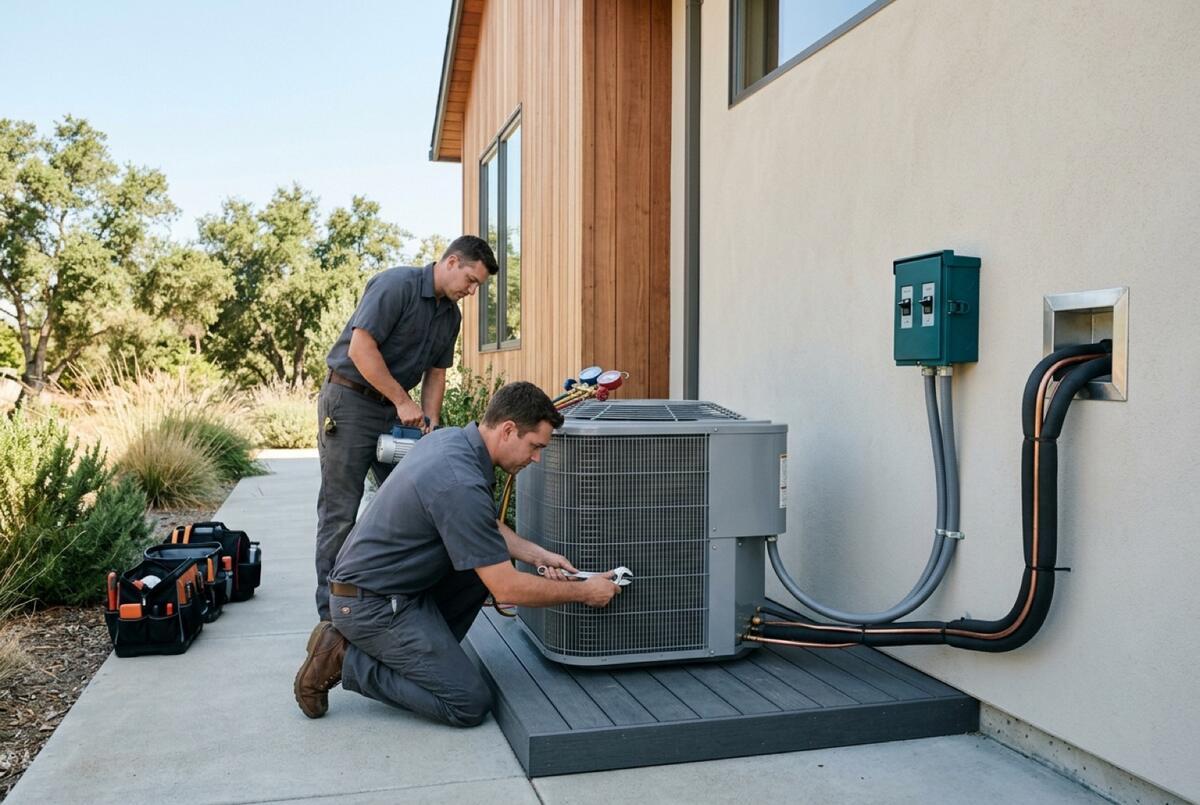
How Much Does a Heat Pump Cost in Sacramento?
What does a ducted heat pump cost in Sacramento? See the planning range for a full change-out, the factors that move it, and how rebates and electrical fit in.
Last reviewed:
Planning ranges
| Scope | Planning range | What's in it |
|---|---|---|
| Ducted heat pump (full change-out) | $12,000–$22,000per system | A full ducted heat pump change-out that replaces both the AC and the furnace with one system. A planning estimate only; home size, efficiency, duct condition, and any electrical work move it, and the exact figure comes from an on-site inspection. |
What moves the cost
- Equipment size — set by a load calculation (square footage, insulation, windows, ducts), not the old system's tonnage; correct sizing matters more with a heat pump because it runs longer at lower output.
- Efficiency level — higher-efficiency heat pumps cost more upfront and widen the top of the range; running-cost savings depend on how much you heat and cool.
- Ductwork condition — heat pumps move more air at lower temperatures, so undersized returns or leaky ducts that were tolerable before may need work, shown as a separate line item.
- Electrical — heat pumps run on electricity and sometimes need a panel or circuit upgrade, typically $2,500-$5,500 when required; the inspection confirms whether it's needed rather than assuming it.
- Access — attic air handlers, tight side yards, and difficult outdoor-unit locations add labor.
- Permits — required region-wide for a change-out, with the jurisdiction depending on your address (city vs county).
- Thermostat and controls — heat pump systems often want a compatible thermostat, which can be a small add.
- Backup/auxiliary heat — a heat pump usually pairs with electric-resistance backup for the coldest mornings, which is part of the design and can affect the electrical scope.
- Rebates — a qualifying project may reduce net cost, but eligibility depends on the current program, equipment, utility territory, and contractor requirements, so it's never guaranteed.
Sacramento-specific factors
- Heat load — sizing must hold up under sustained summer heat while also covering Sacramento's mild winters, where a heat pump is a practical primary heat source.
- Older ducts — pre-war and mid-century homes often have duct runs that need sealing or resizing to carry the higher airflow a heat pump wants.
- Attic conditions — attic duct temperatures run far above outdoor readings, so airflow losses show up quickly in comfort and may need addressing during the install.
- Jurisdiction — permit authority differs; incorporated cities issue their own, and unincorporated Carmichael and Fair Oaks go through Sacramento County. Roseville's rebate adds a Title 24 duct-test requirement.
- SMUD / PG&E territory — most area homes are SMUD electric, where a qualifying heat pump may open rebate options; PG&E-territory areas like West Sacramento use a different, currently-waitlisted channel, so verify before counting on it.
What's included in the range (and what isn't)
The planning range covers the core project: qualifying heat pump equipment, standard labor, a standard installation, and the permit. It excludes the variable extras an inspection surfaces — duct replacement or major sealing, and electrical panel or circuit upgrades (typically $2,500-$5,500 when required). Because a heat pump depends more on ductwork and electrical than a straight AC swap, those items are more likely to come up here, which is exactly why we inspect before quoting and give the exact number in writing. A quote near the bottom of this range that doesn't mention duct condition or confirm your panel capacity should raise a question rather than excitement — those are the two pieces most likely to move the real number, and a scope that ignores them isn't cheaper, just incomplete. The HVAC cost calculator lets you preview how those pieces shift the estimate, and if you're still deciding whether to replace at all, the repair-or-replace guide is the better first stop.
Where the money actually goes: equipment, labor, permit, ductwork, electrical
A ducted heat pump breaks into the same component stack as any change-out, just weighted differently. Equipment — the outdoor heat pump, the matched indoor air handler or coil, and controls — is the largest share and the piece efficiency choices move most. Labor covers removal of the old AC and furnace, the new install, refrigerant handling, and commissioning; an attic air handler in a tight space costs more to install than a garage location. The permit is a smaller fixed cost but non-optional. Ductwork matters more here than on an AC-only job: heat pumps deliver a larger volume of cooler air, so undersized returns or leaky runs that a furnace tolerated can undercut comfort, and correcting them is a separate line item. Electrical is the factor most unique to heat pumps — because the system runs entirely on electricity, an older panel may need a service or circuit upgrade (typically $2,500-$5,500 when required). Those last two conditional pieces are why two similar homes can sit at opposite ends of the range.
- City building department
- Sacramento, Elk Grove, Roseville, Folsom, Rancho Cordova, Citrus Heights, West Sacramento and Davis
- Sacramento County
- Carmichael and Fair Oaks
Why a heat pump costs more than an AC-only swap
A ducted heat pump replaces both your AC and your furnace with a single system, so you're comparing it against a full AC-and-furnace change-out, not an AC-only swap. It can also involve more duct and electrical work, since it moves more air and runs on electricity. The tradeoff is one efficient system handling year-round comfort, often with rebate potential for qualifying projects. Whether it beats a like-for-like AC-and-furnace replacement depends on your ducts, your electrical, and how long you plan to stay — which is a comparison worth running with real numbers. Our repair-or-replace guide helps frame it, and the AC replacement cost guide gives the comparison range.
Efficiency (SEER2 and HSPF2) and what it buys you here
Heat pumps carry two efficiency ratings: SEER2 for cooling and HSPF2 for heating, both current federal test standards. Equipment that earns the ENERGY STAR label (energystar.gov (opens in new tab)) is certified above the federal minimums, and the U.S. Department of Energy's overview of air-source heat pumps (energy.gov (opens in new tab)) explains how modern variable-speed units hold efficiency across a wide temperature range. In Sacramento's climate — hot summers, mild winters — a heat pump is a practical primary heat source, and a higher-efficiency, variable-speed unit can pay back through both seasons because it runs so many hours. The higher tiers are what push toward the top of the planning range. They also tend to be the equipment that qualifies for rebates, so efficiency, upfront cost, and rebate eligibility are worth weighing together rather than one at a time.
Popular add-ons and where they fit
Common extras that come up on a heat pump project:
- Duct sealing or resizing — heat pumps want good airflow, so correcting leaky or undersized runs is the most common add; it's ductwork and airflow work shown as its own line.
- Electrical panel or circuit upgrade — only when the inspection finds the panel can't support the equipment (typically $2,500-$5,500 when required); never assumed into the base range.
- Compatible smart thermostat — heat pump staging benefits from a matched thermostat; per ENERGY STAR (opens in new tab) a well-configured one can reduce runtime.
- Improved filtration — a better filter setup supports indoor air quality, useful during wildfire-smoke season.
- Zoning or a mini-split add — for a room the ducts can't reach, a ductless mini-split zone can complement the ducted system.
How to compare heat pump quotes fairly
Line up quotes on more than the bottom-line number:
- Sizing basis — a load calculation, not a guess off the old equipment.
- Equipment match — same efficiency tier (SEER2 and HSPF2) and heat pump class across quotes.
- Duct and electrical scope — does the quote address duct condition and confirm electrical capacity, or assume both are fine?
- Permit — included, with the correct jurisdiction identified.
- Rebate handling — is any rebate presented as "may qualify, verify current program," or over-promised as a guaranteed amount?
What actually moves your number within the range
A heat pump's planning range is wider than an AC-only swap for a reason, and the same handful of conditions decide where a specific home lands. The first is electrical: because the system runs entirely on electricity, an older Sacramento home with a dated panel may need a service or circuit upgrade (typically $2,500-$5,500 when required), while a home with modern capacity skips that line entirely — this single factor separates the low and high ends more than any other. The second is duct condition: heat pumps move a larger volume of cooler air, so returns and runs that a furnace tolerated can undercut comfort and may need sealing or resizing. The third is efficiency tier: a standard unit sits lower, while a high-SEER2, high-HSPF2 variable-speed system widens the top of the band and tends to be the equipment that qualifies for rebates. The fourth is access — an attic air handler in a tight space costs more to install than a garage location. Because two of those four (electrical and ducts) are conditional and only knowable on-site, the inspection is what turns the planning range into a firm written number for your house.
How rebates, credits, and running costs change the long-term math
A heat pump's total cost of ownership isn't just the install price — it's the install price, minus any rebates or credits, plus what it costs to run over the years you keep it. The planning range above is the install price before any incentive, kept separate on purpose. On the incentive side, a qualifying high-efficiency heat pump may open SMUD rebate options, which hinge on current program rules and equipment that meets the thresholds; our SMUD heat pump rebates resource covers the utility side. The federal 25C tax credit covered improvements made through December 31, 2025, and the IRS (opens in new tab) says it can't be claimed for property placed in service after that date, so don't count on it for a new install unless the law changes (checked October 6, 2026). We never bake an assumed rebate or credit into an estimate. On the running-cost side, the U.S. Department of Energy notes that a single efficient heat pump handling both heating and cooling can be cheaper to operate than a separate AC-plus-gas-furnace pair in a mild climate like Sacramento's, especially as a variable-speed unit modulates instead of cycling. Whether the year-round efficiency justifies the higher upfront number over a like-for-like AC-and-furnace replacement depends on your rates, your ducts, and how long you plan to stay — which is exactly the comparison worth running with real numbers before you commit.
- SMUD
- Sacramento, Elk Grove, Folsom, Rancho Cordova, Citrus Heights, Carmichael and Fair Oaks
- Roseville Electric Utility
- Roseville
- PG&E
- West Sacramento
- Valley Clean Energy (generation) + PG&E (delivery)
- Davis
Related services
Heat Pump Install
Heating and cooling on one efficient system.
AC Installation
Right-sized replacement with a written scope.
Ductwork & Airflow
Fix the delivery, not just the equipment.
Mini-Splits
Comfort for the rooms the ducts forgot.
Thermostats
Controls that do what you tell them.
Related guides
SMUD Heat Pump Rebates: What Sacramento Homeowners Should Know
SMUD offers heat pump rebates for qualifying Sacramento-area homes, but amounts and eligibility change. Here's how the program works and what to verify first.
Local rules · ReviewedRepair or Replace Your HVAC System? A Sacramento Decision Guide
Deciding whether to repair or replace your AC or furnace? Weigh age, repair cost, refrigerant, efficiency, and comfort, plus the $5,000 test.
Cost and decisions · ReviewedThe R-410A Refrigerant Transition: What It Means for Your AC
New AC systems use lower-GWP refrigerant, existing R-410A systems can still be serviced, and older R-410A stock can still be installed. What that means for you.
Cost and decisions · ReviewedDo You Need a Permit to Replace HVAC in Sacramento?
Replacing an AC or furnace in the Sacramento area needs a permit — and who issues it depends on your city or unincorporated county address. Here's how it works.
Local rules · Reviewed
Planning tools
HVAC replacement cost calculator
Planning ranges for AC, furnace, heat pump, and mini-split replacement.
AC repair vs replace calculator
Weigh age, repair cost, refrigerant, and comfort to see which way the math leans.
Frequently asked questions
How much does a heat pump cost in Sacramento?
A ducted heat pump that replaces both your AC and furnace runs a planning range of about $12,000 to $22,000 in the Sacramento area. It's an estimate, not a quote — home size, efficiency, duct condition, and any electrical work move it, and the exact figure comes from an on-site inspection.
Why does a heat pump cost more than replacing my AC?
Because it replaces both your AC and your furnace with one system, so the right comparison is a full AC-and-furnace change-out, not an AC-only swap. Heat pumps can also involve more ductwork and electrical work since they move more air and run on electricity. The upside is one efficient system for year-round comfort, with rebate potential for qualifying projects.
Will I need an electrical upgrade for a heat pump?
Sometimes, not always. Heat pumps run on electricity and occasionally need a panel or circuit upgrade — typically $2,500-$5,500 when required. It isn't automatic, and it isn't built into the base range. The on-site inspection confirms whether your panel and circuits can support the equipment before it becomes a surprise mid-install.
Is a heat pump efficient enough for Sacramento winters?
Yes. Sacramento's winters are mild, which is close to ideal for an air-source heat pump — the U.S. Department of Energy notes that modern variable-speed heat pumps hold efficiency well across the temperatures this region sees. A properly sized system handles the heating season as a primary source, usually paired with electric-resistance backup for the coldest mornings. The HSPF2 rating measures heating efficiency, and a higher-rated unit is worth weighing against how much you heat.
What SEER2 or HSPF2 rating should I look for?
Both ratings have federal minimums, and higher numbers mean more efficiency: SEER2 for cooling, HSPF2 for heating. Equipment with the ENERGY STAR label sits above the federal floor and is often what qualifies for rebates. Because a heat pump runs many hours across both seasons here, a mid-to-high tier frequently pays back — but the right pick depends on your home and how much you run it, which is why we present the tiers rather than defaulting to the top. Higher tiers are what widen the upper end of the planning range.
Does the range include heat pump rebates?
No — the range is before any rebate. A qualifying project in SMUD territory may have rebate options, but eligibility depends on the current program, the equipment, your utility, and contractor requirements, so we don't build an assumed rebate into the estimate. We cover what may apply and point you to the current program to verify the amount. See our SMUD heat pump rebates resource for how eligibility works.
Get an exact figure for your home
Planning ranges are a sanity check, not a quote. 916air inspects the home, explains the options, and puts the real number in writing before any work.